
90-Day Revenue Conversion Sprint
Build the website, AI intake, CRM, and reporting fixes that turn more leads into booked jobs.
A practical implementation sprint for home services companies that need better conversion, faster response, cleaner routing, and clearer leadership visibility.
Typical investment: $25,000-$50,000
Purpose
Improve the revenue capture process without boiling the ocean.
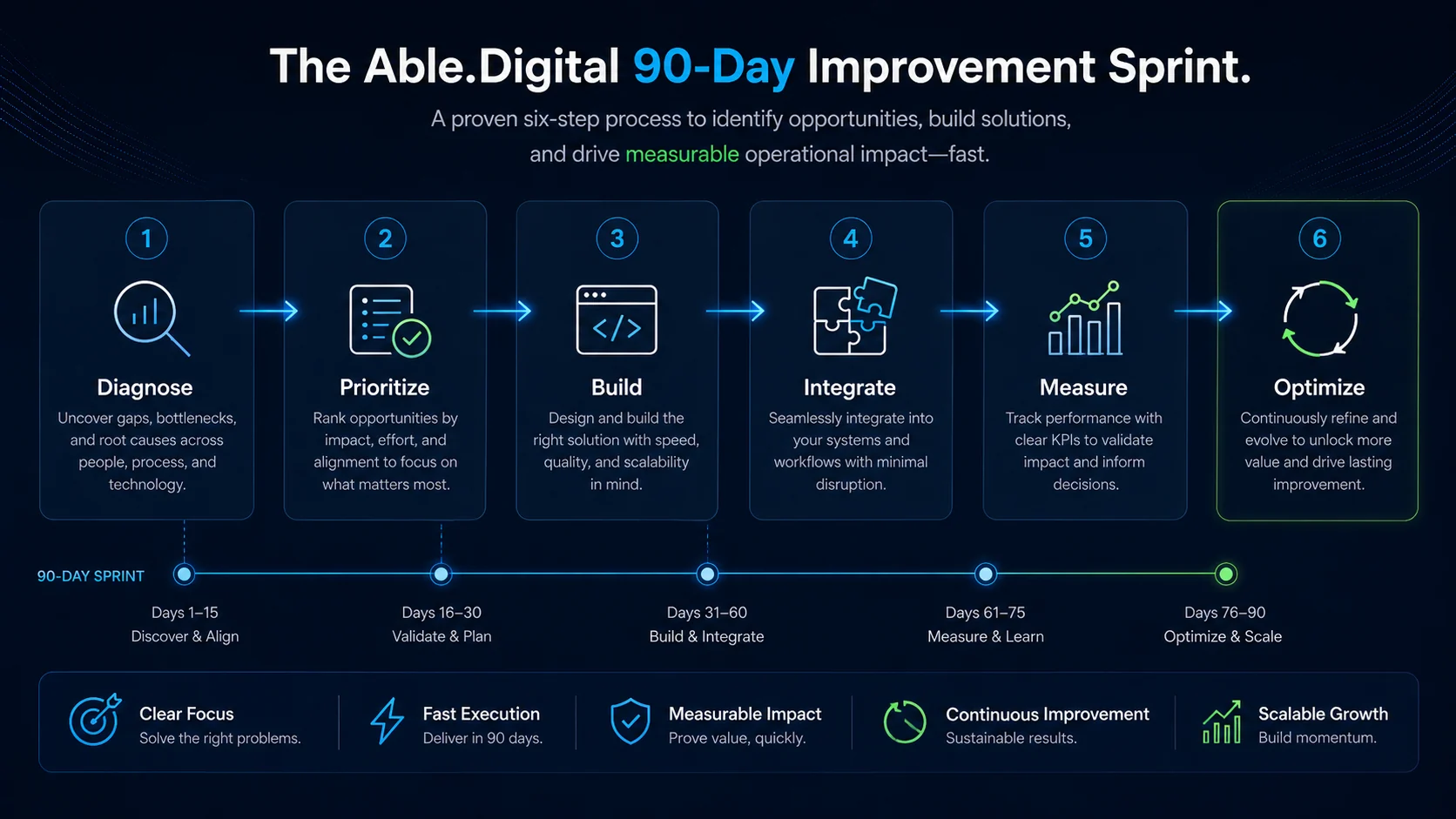
The sprint focuses on the practical fixes that most directly affect lead conversion and operational visibility: stronger pages, better forms, AI-assisted intake, CRM routing, notifications, source tracking, dashboard visibility, and clean sales or dispatch handoff.
This is not a six-month enterprise transformation. It is a focused build cycle designed to create visible operating improvements in 90 days.
Best fit
Companies that already know the system is leaking revenue and need a hands-on team to modernize key pages, intake workflows, CRM routing, and reporting.
Sprint workstreams
What gets built or improved
Website or landing page modernization
Sharper service pages, location pages, service-area pages, quote requests, mobile CTAs, credibility blocks, and offer messaging.
AI chatbot / AI lead assistant
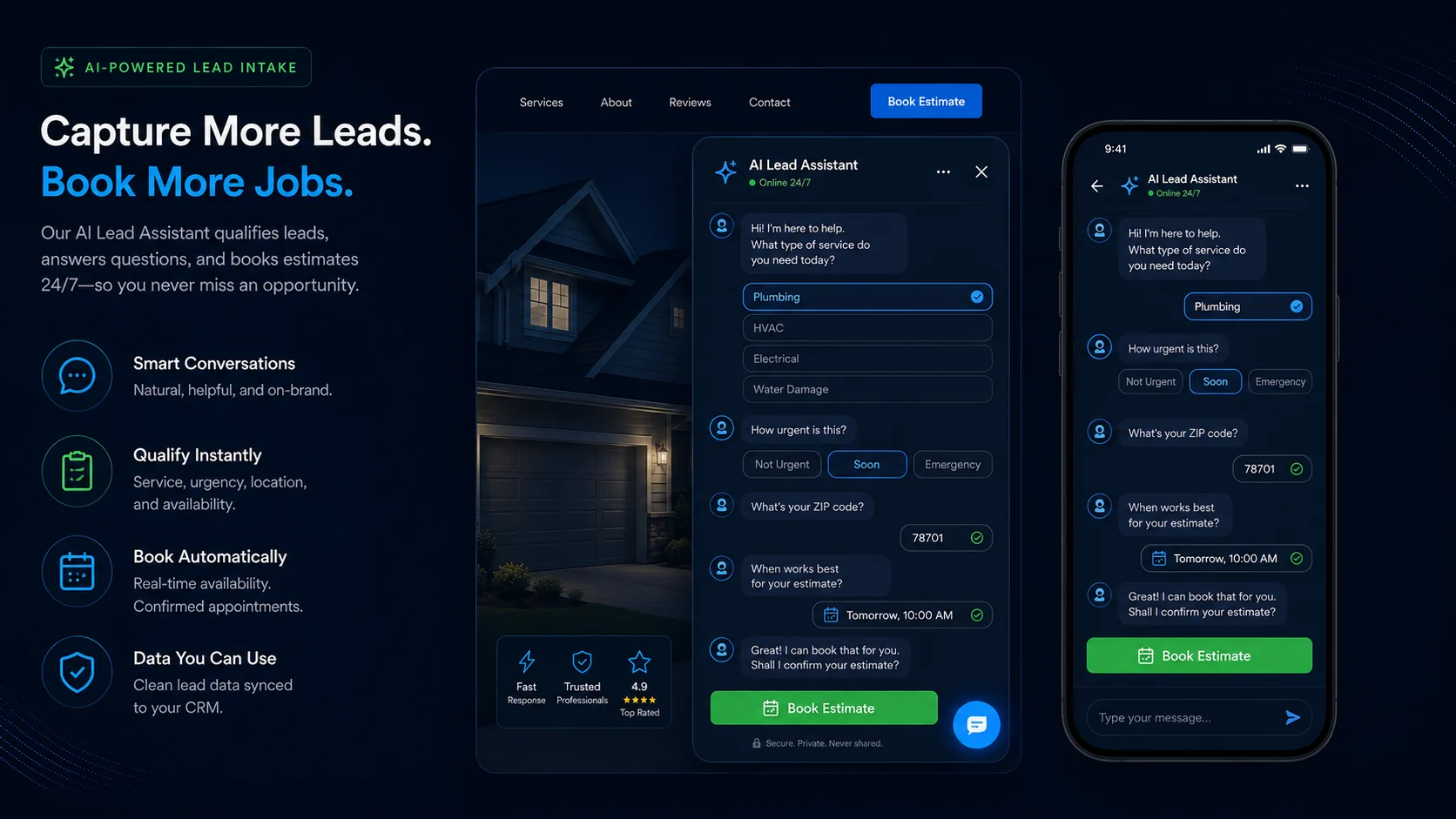
Conversational intake that collects service need, urgency, ZIP code, property type, issue details, and contact information.
Lead qualification flows
Forms and flows that route emergency, high-value, repeat, warranty, commercial, and low-fit requests appropriately.
CRM-lite app or CRM integration
Use Salesforce, HubSpot, Supabase, or your current stack to capture clean lead records and source data.
Lead routing and notifications
Assign leads by service area, branch, service line, urgency, or sales ownership with alerts and follow-up expectations.
Dashboard and reporting improvements
Track booked estimates, source attribution, lead response, branch performance, and conversion bottlenecks.
90-day structure
A focused implementation cadence
Discovery and sprint design
Confirm target services, branches, lead sources, systems, routing logic, CRM fields, reporting requirements, and conversion priorities.
Build and integrate
Develop page improvements, forms, AI intake flow, routing rules, CRM updates, notifications, and tracking architecture.
Launch and adoption
Deploy the sprint assets, test handoffs, train internal users, validate records, and monitor early conversion behavior.
Measure and optimize
Review performance, improve messaging, fix workflow gaps, tune chatbot behavior, and define the next roadmap.
Outputs
Designed to create usable operating assets.
By the end of the sprint, leadership should have clearer visibility into how leads are captured, qualified, routed, followed up, and reported.
- Modernized core conversion pages or landing pages
- Improved service-area and location page structure
- AI lead assistant intake script and escalation logic
- Lead qualification forms and routing workflows
- CRM-lite workflow or CRM integration
- Call-to-form conversion improvements
- Estimate request workflows
- Source tracking and attribution setup
- Dashboard and reporting improvements
- Monthly optimization recommendations
FAQ
Questions executives usually ask first
Is the sprint only for companies using Salesforce or HubSpot?
No. We can work with Salesforce, HubSpot, Supabase, Netlify forms, CRM-lite builds, and many existing home services software stacks. The sprint is designed around your operating workflow.
Will this replace our marketing agency?
Not necessarily. We can coordinate with your agency and focus on conversion, systems, intake, routing, and reporting. If the agency is strong at traffic, we help make that traffic more valuable.
Can you build an AI chatbot during the sprint?
Yes, when the use case is appropriate. The chatbot should qualify leads, route urgent requests, collect useful details, and avoid overpromising service availability.
What happens after 90 days?
You can continue with an ongoing CTO + Growth retainer, run another sprint, or take the roadmap internally.
Next step
Have traffic but not enough booked jobs?
Use a 90-day sprint to fix the highest-leverage conversion and system gaps that are costing your company revenue.